These records are found in the online catalog of The Mariners’ Museum and Park in Newport News, Virginia. Uncurated search results are presented to give researchers and interested readers an idea of whether the museum’s archives contain information about this vessel and whether it may be worthwhile to visit the museum’s catalog search page for further investigation. Uncurated results may be inaccurate or incomplete.
Mariners Museum online catalog search, July 12, 2026. Search phrase: "Kathleen". Catalog returned 67 records; this selection table includes 67 records fetched through catalog result pages.
Use these buttons to send uncurated search results to your own app or text document for further research. First, check the box for any row, or click "Select All" then uncheck any rows. Then click "Show Selections". You can then copy your selections from the text box and past them into your app.
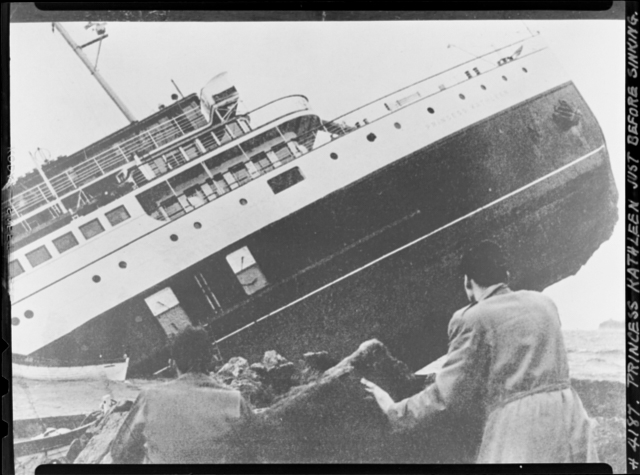
Close-up view of the bow of the Princess Kathleen as it is sinking. There are two men watching by rocks in the foreground. The bow of the ship is out of the water as the ship is sinking stern-first.
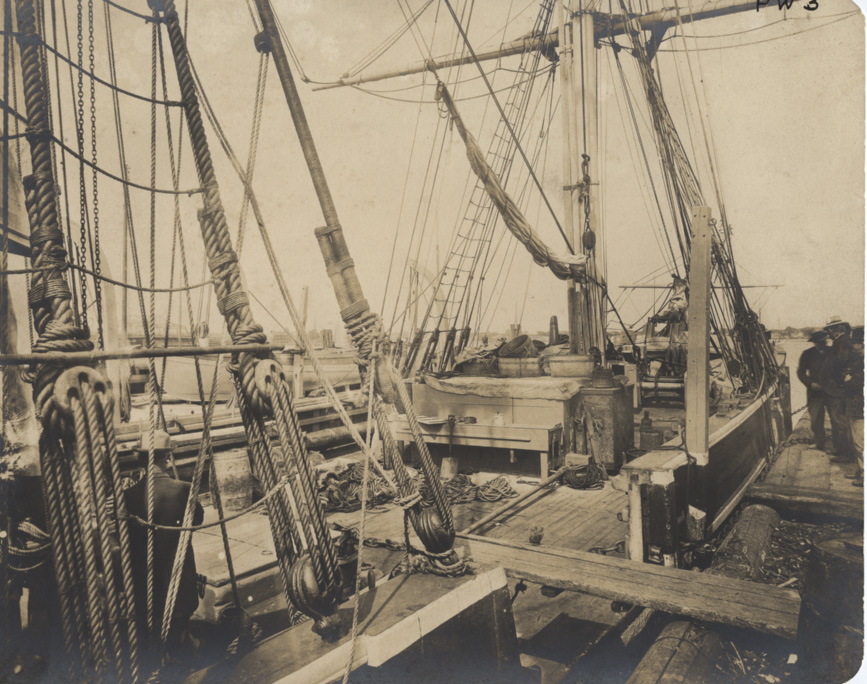
Bark KATHLEEN sunk by a whale : - as related by the captain, Thomas H. Jenkins : to which is added an account of two like occurrences, the loss of ships ANN ALEXANDER and ESSEX
"Medical Officer and army nurses of the hospital train waiting to meet the wounded soldiers from North Africa. Photo was taken at HRPE Newport News, Va. 11-25-42 Official photograph USArmy Signal Corps HRPE Newport News, Va."; stamped in black "Confidential"
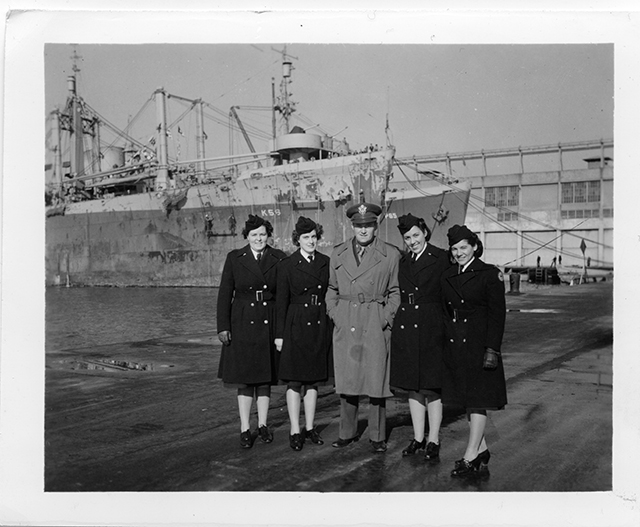
Portrait of Major Martin J. Rosenthal, Commander of a hospital train, with four nurses: Lt. Kathleen Williams, Lt. Marjorie E. Mattson, Lt. Viola B. Heydens, and Lt. Veronica J. Janis. They are standing on a pier with the Oberon (AK-56) and the Calvert (AP-65) in the background.
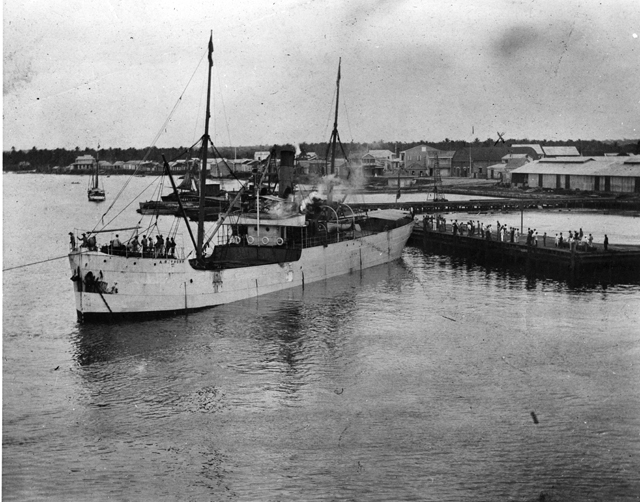
WRITTEN ON VERSO: FORMERLY KATHLEEN, BUILT1894, AT STOCKTON BY CIGAR, TAYLOR COMPANY 1055T, 218 X 33.1 X 13.8. OWNED BY ATTIES, HEKLA. RENAMED ELLA, ERNA ORIOLE.
Port side view of steamship departing dock. People seen on dock with small town in background. Ella, Erna, Kathleen, Oriole.
Pfc. Charles H. Simons, 33480459, Haverford, Pennsylvania, 633d Ordnance Ammunition Company (shipment RE-7374-N) is shown greeting his wife, Cpl. Kathleen T.G. Simons, A-318643, Haverford, Pennsylvania, Motor Pool Dispatcher, soon after debarking USS USSR VICTORY (HR-1028), which left Marseilles, France, 19 Oct. 1945, with 115 officers and 1182 enlisted personnel, totaling 1947 troops.
Army spouses–Virginia–Newport News.
Shows a soldier and his wife, a WAC, sitting on a bench. He has his arm around her.
3rd Officer Kathleen MacKnight, British WREN, Linlithgow, Scotland, who had entered the WRENS 27 Jun 40 after Dunkirk and the fall of France. She had attended the University of Edinburgh, 1939-40. She had come to the US by NY on 12 Nov. 43 on the HS AQUITANIA and was assigned to the British Admiralty, Washington, D.C. Shown on Pier 6, HRPE, Newport News, Va., before embarking on USS WEST POINT. Photo taken for Historical purposes.
Embarkation (Military science).
Seven women smile for the camera as they wait for embarkation.
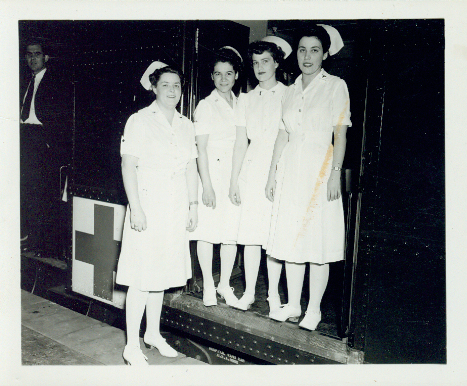
"Army nurses standing in front of Medical Department Hospital Ward Car, USA 8906, which was waiting for disembarkation of 204 American soldiers from Tunisia. (left to right) Kathleen A. Williams, N-731532; Veronica J. Janis, N-731430; Marjorie E. Mattson, N-731433; Viola B. Haydens, N-731527. 5-29-43 Official photograph U.S.Army Signal Corps, HRPE, Newport News, Virginia"; stamped in black "Secret"
Hospital trains–Virginia–Newport News.
Four Army nurses standing in and in front of the hospital train car. There is a man standing to the far left of them.
E8866 - Kathleen Harris is shown singing "Long Ago and Far Away" at the opening night of the new outdoor theatre at Camp Patrick Henry. 7-21-44 Official Photograph, U. S. Army Signal Corps, HRPE, Newport News, Va.
Audiences–Virginia–Newport News.; Women singers–Virginia–Newport News.
A woman stands on and outdoor stage at night in a formal dress, singing at a microphone.
Winners of the door prizes are shown with Mr. Geo. Kare, civilian branch, training section, of Pittsburgh, PA., who drew the prizes from the kettle. Left to right: Mr. Geo. Kare; Sgt. Solomon Robinovich, 35th Italian SE vice unit, Norfolk Army Base; Kathleen Allen, Ghent Hotel, Norfolk, Va.; Jessie E. Turner 96 Gillis Road, Craddock, Portsmouth, VA., and H. Robert Seele, G-M, 2C 123 Elm St Tenafly, N.J., civilian cafeteria, Norfolk Army Base. Nov. 2, 1945.
Contests–Virginia–Norfolk.
Shows a man holding a pot, he is reaching his hand in to draw up the winner's names. There are two men and two women smiling broadly, they have received prizes.
E6673 - Mrs. Madeline Carroll Hamilton visits with fellow Red Cross workers at the Station Hospital , Camp Patrick Henry. L. to R. starting with front row are: Wilma Pippert, Elton R. Mead Red Cross Field Director at CPH, MAdeline Carroll Hamilton, Rebekah C. Preston, Asst. Field Director Anne Hockstein, Ester Patz, Kathleen Tate, Elizabeth J. Hadley, Mrs. Estelle K. Abernathy of 126 James River Dr., Hilton Village, Va., and Mrs C. Alderson of 319 Hurley Ave, Hilton Cillage, Va. The latter three are Grey Ladies of the Newport News-Warwick County Chapter of the American Red Cross. 2-26-44 Official Photograph, U. S. Army Signal Corps, HRPE, Newport News, Va.
Military hospitals–Virginia–Newport News.
Madeleine Carroll, a star of silent and "talkie" films through the mid-40s, joined the Red Cross after the death of her sister in a London air raid. Here she is shown visiting wounded soldiers.
Lighthouses of Maine and New Hampshire: - a pictoral tour of the lighthouses of Maine and New Hampshire - by Kathleen E. Finnegan and Timothy E. Harrison
The daughter of an Army general and wife of a former nuclear sub- marine skipper know that support given by the U. S. Navy to familiesof men away from home can critically affect retention rates.
Photograph of the Camp Patrick Henry Choir, personnel. (Refer to caption sheet for list of names.)
Choirs (Music)–Virginia–Newport News.
Shows 21 members of the CPH Choir. They appear to be standing in front of the Chapel-in-the-Woods. The 8x10 print reads: First row (left to right): Pvt. Katie Dunn, A-809078, Gainesville, Tex.; Pfc. Winifred V. Conger, A-220455, New Vernon, N.J.; Pfc. Katharine A. Miller, A-306287, York, Pa.; T/5 Mary A. Brooks, A-504600, Columbus, Ohio; Pfc. Jean O. Barton, A-409248, Vicksburg, Miss.; Mrs. Edward T. Ormsby, Dundalk, Md.; Miss Elaine Hjortland, Milwaukee, Wis.' and Mrs. Benjamin T. Nelson, Volga, S.D. Second Row (Left to right): Pvt. Josephine E. Marshall, A-120515, Miami, Fla.; T/5 Antoinette D. Guyer, A-305353, Philadelphia, Pa.; Pvt. Lydia M. Brown, A-319092, Barrington, N.J.; T/5 Thelma A. Conine, A-504857, North Baltimore, Ohio; 1st Lt. Doris W. Nevison, L-220455, Nutley, N.J.; Mrs. Dayle E. Garrett, Lexington, Ill.; Mrs. Elmer S. Hjortland, Milwaukee, Wis.; Mrs. Merl D. Williams, Wiwaukee, Wis. Third Row (Left to right): Lt. Col. Herbert A. Jones, O-138893, Brooklyn, N.Y.; Major Philip T. Raymond, O-499283, Columbus, Ga.; 1st Lt. Charles B. Edwards, O-1287327, Brentwood, Pa.; Sgt. Dayle E. Garrett, 16073751, Lexington, Ill.; and Miss Kathleen Wampler, Newport News, Va. Fourth Row (left to right): Sgt. Pat Garnet, 34657876, Spartanburg, S.C.; T/4 Merl D. Williams, 36958854, Milwaukee, Wis., Director; Pfc. Robert B. Pinson, Jr., 38418184, Anniston, Ala.; Pfc. John A. Backus, 39537261, Inglewood, Calif.; and T/4 Earl F. Schmogrow, 35797176, Cheviot, Ohio, organist.
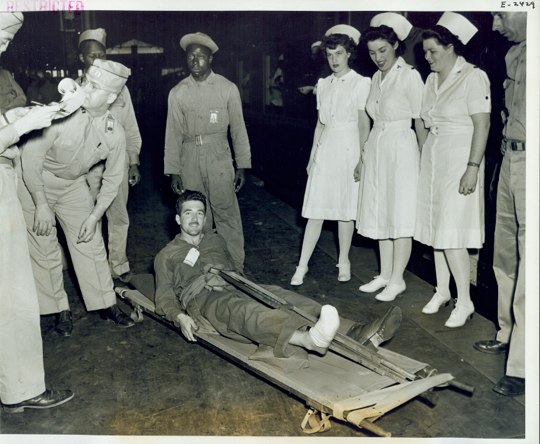
"Pfc. W.A. Green, Jr. 32066551, on litter waiting to enter hospital war car, able to walk with crutch. Wounded in right foot on April 3, 1943, in bombing raid in attack on Regimental Headquarters of 47th Infantry, 9th Division, received fracture of toes, laceration of ribs, This wounded man was placed on hospital ward car on Pier 5, and taken to Valley Forge General Hospital, Phoenixville, Pa. 5-29-43 Official photograph U.S.Army Signal Corps, HRPE, Newport News, Virginia"; stamped in black "Secret"
World War, 1939-1945–Casualties–United States.; Litters–Virginia–Newport News.
Private First Class W. A. Green, Jr. on a stretcher with a crutch. Nurses and other men stand around him.
"L3177 - Group of army nurses waiting to board ship for duty overseas at pier 6, HRPE, Newport News, Va. 7-13-43 Official photograph U.S.Army Signal Corps, HRPE, Newport News, Va."; stamped in red "Secret"
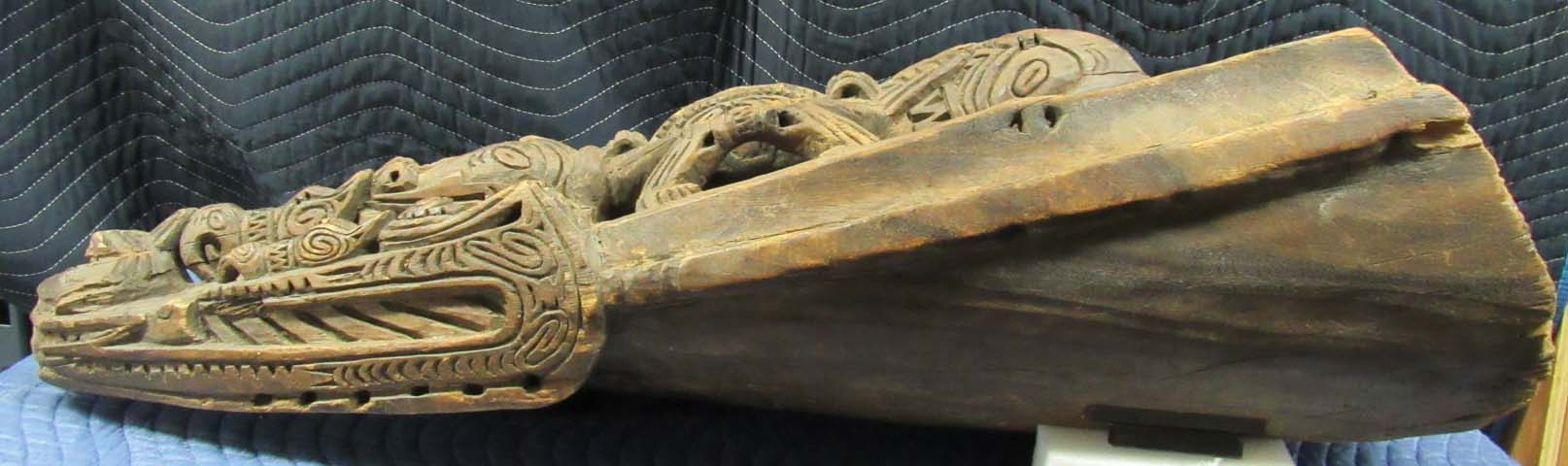
LOWER SEPIK RIVER REGION - PAPUA NEW GUINEA - Maker
SHORT DESCRIPTION: Stylized carving of crocodile and spirit bird motifs that originally decorated the prow of a large dugout canoe (beginnings of canoe shape visible). Beak-like bird is a spirit face with large eyes. NOTES: Collected on "La Korrigane" voyage. Between 1934 and 1936, the La Korrigane expedition, backed by the Trocadéro Ethnographic Museum, sailed the South Pacific under the command of Count Etienne de Ganay. Their mission was to conduct explorations and collect ethnographic objects. The voyage—the last great ethnographic expedition—was the subject of an exhibit at the Musée de l'Homme in 1938, returned with more than 2000 artifacts, a great number of which originated from still unexplored territories. The objects remained at the Musée de l'Homme until 1961, at which time they were auctioned in Paris (Collection Océanienne du Voyage de la Korrigane, Hôtel Drouot, Paris, December 4th & 5th). The mark D. 39.3/1000 means that the object was deposited at the Musée de l’Homme in Paris in March 1939. The '1000' may mean this was the thousandth object in the deposit. VESSEL HISTORY: Korrigane was a schooner, used for cod-fishing in Iceland that was turned into an exploration vessel in 1934-1936. The expedition departed Marseille on March 28, 1934, crossed the Panama Canal and sailed through the Pacific Ocean for a year and a half traveling first to Polynesia (Tahiti, the Marquesas, Fiji) and Melanesia (New Caledonia, New Hebrides, Solomon Admiralties and New Guinea). The voyage returned to Marseille June 17, 1936 via Indonesia, Ceylon and Egypt. ADDITIONAL INFORMATION: See A. Buehler, "Art of the South Sea Islands" p, 77, 118-119. Kathleen Barlow and David Lipset, "The Fabrication of Canoes in the Murik Lakes".
At head of title: The American Historical Association. Copyright date, 1930, corrected in manuscript to 1931. "This volume is published from a fund contributed to the American Historical Association by the Carnegie Corporation of New York" p. [iv].
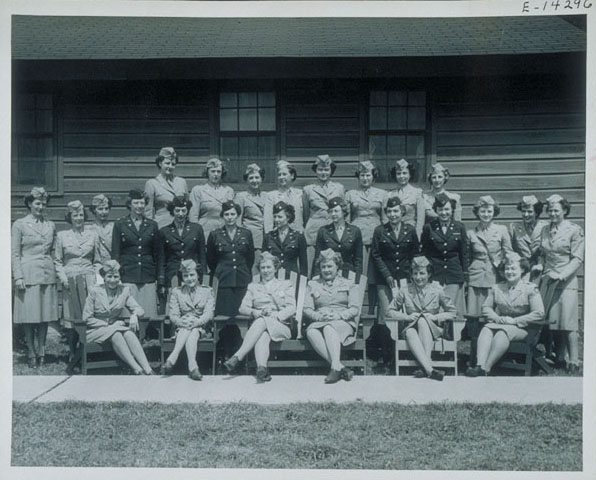
Shown here are members of the third annual Women's Army Corps Staff Directors Conference. They are shown at Camp Patrick Henry where they lunched with the Third WAC Company. Photo taken at CPH. (Refer to Caption sheet for list of names.)
Group portrait of 27 WAC officers. They are outdoors in front of a building.
Emil and Kathleen Sick lecture-book series in western history and biography.
Lumber trade–History–Pacific Coast; Sawmills–History–Pacific Coast; Bois–Industrie et commerce–Histoire–Pacifique, Côte du; Scieries–Histoire–Pacifique, Côte du
E-11113 - Group photograph of HRPE WAC Officers, HRPE, Newport News, Va. Photo taken for Historical purposes. 12-2-44 Official Photograph, U. S. Army Signal Corps, HRPE, Newport News, Va.
Portraits, Group–Virginia–Newport News.
Shows WAC officers in uniform posing in several rows for a group portrait. Marked as the HRPE Gym in the index.
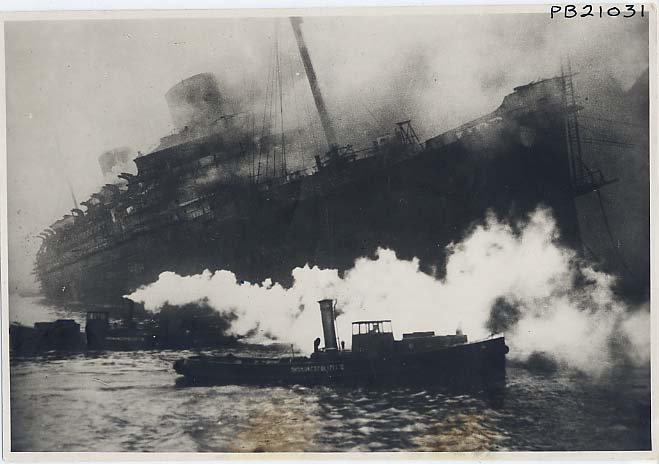
STEAMSHIP, BUILT 1928, AT HAMBURG, BY BLOHM & VOSS. OWNED BY NORDEUTSCHER LLOYD. 49.746 T. 890.2X102.1X438. RENAMED LIBERTE, SCRAPPED 1962
Steamboats.; Fire; Disasters
CURATOR NOTES: Starboard side of sinking vessel afire; see PB12526 . The SS Europa (later SS Liberté) was one of a pair of fast ocean liners built in the late nineteen-twenties for the Norddeutsche Lloyd line (NDL) for the transatlanticTransatlanticThe term transatlantic refers to something occurring all the way across the Atlantic Ocean. Most often, this refers to the exchange of passengers, cargo, information, or communication between North America and Europe.-Transatlantic crossings:...passenger service. Her sister ship was the , and the two were very similar, though not identical (the Bremen was slightly larger, among other differences). Construction Europa was built in 1929 with her sister ship BremenSS Bremen (1929)The SS Bremen or TS Bremen of 1929 was one of a pair of ocean liners built for the Norddeutscher Lloyd line for the transatlantic passenger service. The Bremen was notable for her low streamlined profile, and modern approach to her design. Her sister ship was the , later renamed Liberté... and to be the second 50,000 grosse tons North German Lloyd. With both ships, the NDL will reach the top class shipping company of Atlantic traffic once more. Europa and her sister were designed to have a cruising speed of 27.5 knotsKnot (speed)The knot is a unit of speed equal to one nautical mile per hour, which is equal to exactly 1.852 km/h and approximately 1.151 mph. The abbreviation kn is preferred by American and Canadian maritime authorities, and by the Institute of Electrical and Electronics Engineers; however, the... , allowing an Atlantic crossing time of 5 days. This speed enabled Norddeutsche Lloyd to run regular weekly crossings with two ships, a feat that normally required three. The launching of Europa took place at Blohm & Voss shipyard, HamburgHamburgHamburg is the second-largest city in Germany and the sixth-largest city in the European Union... on August 1, 1928. Europa was intended to be completed in spring 1929. However, on the morning of 26 March 1929, a fire broke out while still at the equipment dock. The fire raged all day long and it was not until the evening when the fire was under control. The ship's turbines were damaged heavily and also the remainder of the ship had been significantly damaged. After long discussions between builder and shipping company, it was decided to repair the ship. Within eleven months, the ship was finished and completed on 22 February 1930. The cause of the fire could be never clarified completely. Blue Riband Europa made her maiden voyage to New York on 19 March 1930 taking the westbound Blue RibandBlue RibandThe Blue Riband is an unofficial accolade given to the passenger liner crossing the Atlantic Ocean in regular service with the record highest speed. The term was borrowed from horse racing and was not widely used until after 1910. Under the unwritten rules, the record is based on average speed... from her sister with the average speed of 27.91 knots and a crossing time of 4 days, 17 hours and 6 minutes. Aircraft Like her sister Bremen, Europa had a small seaplane launched from a catapult on her upper deck between the funnels. The airplane flew from the ship to a landing at the seaplane port in Blexen. The pilots and technicians gained experience later applied to equiping German warships with on-board aircraft. The catapult was removed from both Bremen and Europa after a few years of service, because it was too expensive and complex. World War II During World War IIWorld War IIWorld War II, or the Second World War , was a global military conflict which involved a majority of the world's nations, including all great powers, organized into two opposing military alliances: the Allies and the Axis..., she was in GermanGermanyGermany , officially the Federal Republic of Germany , is a country in Central Europe. It is bordered to the north by the North Sea, Denmark, and the Baltic Sea; to the east by Poland and the Czech Republic; to the south by Austria and Switzerland; and to the west by France, Luxembourg, Belgium,...hands and largely inactive. There were plans to use her as a transport in Operation SealionOperation SealionOperation Sea Lion was Nazi Germany's plan to invade England during World War II, beginning in 1940. However, to have any chance of success, the operation required air supremacy over the English Channel..., the intended invasion of Great BritainGreat BritainGreat Britain is an island lying to the northwest of Continental Europe. It is the ninth largest island in the world, and the largest European island. With a population of about 59.6 million people, it is the third most populated island on Earth. Great Britain is surrounded by over 1000 smaller..., and later conversion to an aircraft carrierGerman aircraft carrier I (1942)The German aircraft carrier I was a planned conversion of the transport ship Europa. Conversion planning began in May 1942, but the work was canceled in November 1942 after design problems proved to be irreconcilable.... None of these plans came to pass, and in 1945, she was captured by the alliesAlliesIn general, allies are people, groups, or nations that have joined together in an association for mutual benefit or to achieve some common purpose. In English usage, those who share a common goal and whose work toward that goal is complementary may be viewed as allies for various purposes even when...and used as a troopship, sailing as the USS Europa (AP-177). However, after it was discovered that the ship had infrastructural problems from years of neglect (defective wiring and hull cracks), she was removed from this service. French Line After the war she was turned over to the FrenchFranceFrance , officially the French Republic , is a country located in Western Europe, with several overseas islands and territories located on other continents. Metropolitan France extends from the Mediterranean Sea to the English Channel and the North Sea, and from the Rhine to the Atlantic Ocean...as war reparations and France began to refit her for passenger service. In 1946 while being refitted, she broke free of her moorings during a storm and collided with the wreck of the and sank. She was raised, and in 1950, made her maiden voyage under her new name, Liberté, to New YorkNew YorkNew York is a state in the Mid-Atlantic and Northeastern regions of the United States and is the nation's third most populous. The state is bordered by New Jersey and Pennsylvania to the south, and Connecticut, Massachusetts and Vermont to the east... The refitted Liberté received the colours of the French Line, Compagnie Générale TransatlantiqueCompagnie Générale TransatlantiqueThe Compagnie Générale Transatlantique , known overseas as the French Line, was a shipping company established in 1861 as an attempt to revive the French merchant marine, the poor state of which was painfully highlighted during the Crimean War of 1856. Its first vessel, the S.S..., as well as lengthened funnels. The original squat-shaped funnels had already been lengthened while in service as the SS Europa, to address the problem of exhaust soot coating passengers, but gained further height for the French Line. Following eleven years of service as one of the largest transatlantic liners in the French Line fleet, SS Liberté was laid up in 1961 and scrapped in 1962. SS Liberté also made an appearance in the 1954 classic film SabrinaSabrina (1954 film)Sabrina is a 1954 film directed by Billy Wilder, adapted for the screen by Wilder, Samuel A. Taylor, and Ernest Lehman from Taylor's play Sabrina Fair... , starring Audrey HepburnAudrey HepburnAudrey Hepburn was a British actress and humanitarian.Born in Ixelles as Audrey Kathleen Ruston, Hepburn spent her childhood chiefly in the Netherlands, including German-occupied Arnhem, Netherlands, during the Second World War... and Humphrey BogartHumphrey BogartHumphrey DeForest Bogart was an American actor.After trying various jobs, Bogart began acting in 1921 and became a regular in Broadway productions in the 1920s and 1930s. When the stock market crash of 1929 reduced the demand for plays, Bogart turned to film..., as the ocean liner which features in the final scenes of the film.
A.M. NICHOLSON (SCHOONER: 1900-1928); CHARLES W. MORGAN (WHALING BARK: 1841-PRESENT)
NEW YORK; UNITED STATES
NEW YORK - NEW YORK - UNITED STATES - Manufacturer; NEW BEDFORD - MASSACHUSETTS - UNITED STATES - Related Place
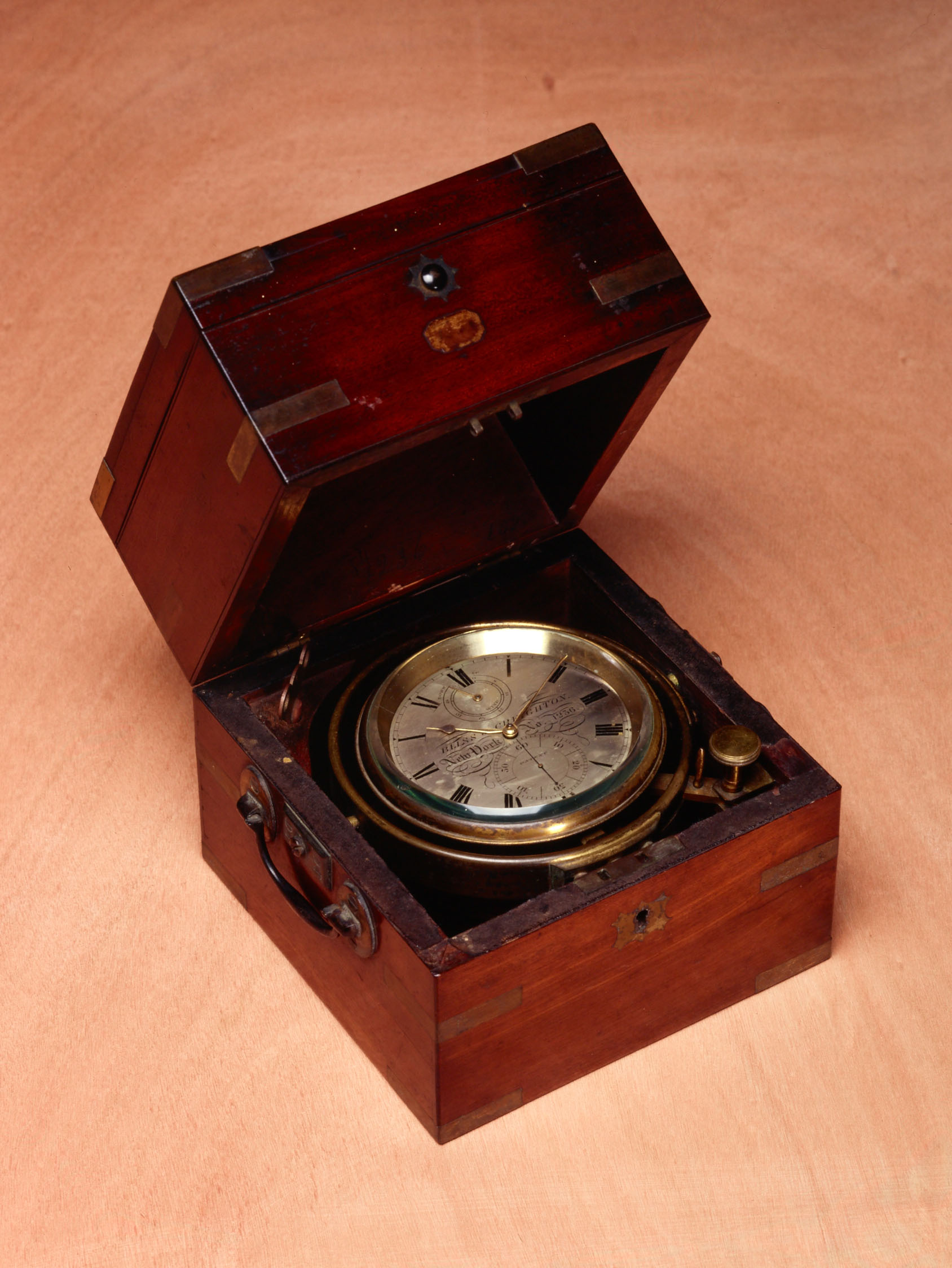
SHORT DESCRIPTION: Ship’s 56 hour chronometer, made by BLISS & CREIGHTON of New York, no 1236. In its original wooden box with glass observation top. According to the object file in 1918 this chronometer belonged to Captain John T. Gonsalves (a black man from Cape Verde) of the whaling schooner A.M. NICHOLSON. Captain John Teofilo Gonsalves was born in Brava, Cape Verde, Portugal on December 16, 1858, he came to America in 1868. According to the American Offshore Whaling database Gonsalves served as master on various vessels from 1890 to 1922, including the Rising Sun (1890-1893), Eunice H. Adams (1893-1894), Baltic (1894-1895, 1897), William A. Grozier (1896), Golden City (1901-1903), Eleanor B. Conwell (1904-1907), Bertha (1907-1909), T. Towner (1911-1914), William A. Graber (1914-1922), A.M. Nicholson (master from 1917 to 1920), and the famous Charles W. Morgan (1920-1921) on her final voyage. Gonsalves died in Cape Verde in March 1928. [Jonathan Betts, 2002] BOX/MOUNTING: Solid, brass bound, three tier, mahogany box, 18.5cms high, 19.5cms wide and 18.5cms deep, with inlaid, brass, shield-shaped lozenge escutcheon on front, and with a lozenge-shaped paper label on front of upper half, numbered (almost indecipherable): "1236", and the button for the lid with inlaid brass star surround. The box has standard fittings, with brass drop handles to sides and lacquered brass gimbals of standard layout except they have no locking wheels on the pivot screws and the winding key (a later replacement) is positioned at the rear left of the box in a wooden corner shelf. The bezel, taking 4 ½ turns to unscrew, is a very early example of the 'open' type with a relatively steep, silvered site ring, and a narrow quadrant moulding with a knurled beading containing a very thick, flat bevelled glass. The brass bowl an eccentric revolving shutter in the base for access to the winding square. The upper half of the box has narrow, scratched moulding at the junctions with lower half and lid and the inside back of the upper half has penned on it: "51-1236" and "139" (possibly 132 or 133). The lid and the upper half have butt hinges keeping them open at 90°. The junction of the box has a green baize covering on the lower half, forming a dust seal when closed. The bottom of the box appears never to have had a green baize covering. DIAL & HANDS: The silvered brass dial is 95.7mmsÆ inset into the brass edge with three steel screws. The brass edge locates the pillar plate of the movement on the other side in the standard pattern, a locating peg at '7 o'clock' the movement fixed in place with three 'pop-marked'brass screws. The dial/movement assembly locates in the brass bowl with a pin in the edge of the brass edge at '3 o'clock'. The dial has plain roman numerals and a seconds dial above VI with arabic ten-second figures, batons at alternate five second intervals and engraved "PATENT" above the centre. Across the middle of the main dial is engraved: "BLISS & CREIGHTON / New York No. 1236 " surrounded by elaborate scrolling. Below XII is an up and down dial, marked in Arabic figures at 8 hour intervals up to 56 hours, marked: "UP", "WIND" (at 24 hours) and "DOWN". The underside of the dial is scratched: "1236", "Kelley", "Cleaned 1857", "Cleaned 1865, New (?) Spring, J S Kelley", "Cleaned 1871", "Cleaned 1871 July by J S Kelley", "do.1877", "1874", "Kelley" "1887 Cln. Kelly" and: "Needs new balance spring / W E Hadlock Boston Sept 1892". Pencilled on the back of the dial is: "Cleaned 1880 Kelley", and "Cleaned by Kelley 1887". Scratched on inside of brass edge is: "1236" and "11". MOVEMENT: Standard-type, one-day full plate fusee movement with four turned and lightly finned pillars, all fixed with blued steel 'pop-marked'screws. The general level of finish, which appears entirely original, is fair, with light, rather uneven, hand spotting all over, except the under-dial brass parts which are left plain. The pillar plate, the balance cock, the potence, the potence plate, the third wheel bar, the fusee bar and the barrel bridge are all punched with one triangular batch mark on the undersides. The upper side of the pillar plate is stamped near the third wheel: "1236". The fusee has a fitted, bell-shaped pipe around the square and Harrison's maintaining power. The maintaining power wheel is scratched: "5", "Kelley 1857", "V" and: "Cleaned W E Hadlock 1892" and is stamped with three dots. Inside the fusee is scratched: "5" and: "1223(3)5". Under the fusee, on the pillar plate is a square patch of very old corrosion, possibly the result of a stuck-on paper label. The brass mainspring set up wheel and click, are mounted on the barrel bridge. The blued steel mainspring is signed, on the outside coil: "G Jiulet (?) New York 10 November 1847 (1842?)". Conventional four-wheel train plus great wheel, of the standard layout. The train pivots have all been bushed during construction and the frame was evidently supplied from Lancashire. ESCAPEMENT, BALANCE & SPRING AND JEWELLING: Typical Earnshaw spring detent escapement with a grey-finished foot detent (now broken in half) originally with a gold passing spring and a pink jewelled locking stone, with a small 'L' section, brass banking piece alongside. The impulse roller has a slightly raked, pink impulse stone and the discharge roller also has a pink discharging stone. The two-arm bimetallic balance has gently curved, tapering steel arms and conforms to the makers' 1845 patent, having 90° bimetal rims running out from both sides of the arms. One pair of rims has brass wedge weights attached (one with a poising sink on the underside), the other rims each have a pair of brass screws one slightly smaller than the other, screwed into the rim. Brass mean-time screws are threaded on the rims at the ends of the arms. The blued steel helical balance spring (now broken at its lower end) has terminals on both ends, the upper terminal attached to a brass pointer stud. The jewelling extends to the balance and escape wheels, with endstones, the lower fourth hole and the escapement parts as mentioned. ALTERATIONS/CONDITION: The chronometer appears to be in substantially original state and the box is sound, though there is some shrinkage across the lid. The finish is a little knocked and grubby, though nicely patinated under the surface grime. The baize box seal is 90% complete. It was originally green but has turned a deep brown coloration The brass furniture is heavily patinated and the gimbals are somewhat tarnished with the lacquer breaking down in places, but all stable. The dial silvering is thinning in patches and around the edges. The movement is generally stable, but the balance spring and the spring detent are both broken (all of balance spring still attached and remains of detent preserved in the box). The potence plate has some brown finger printing, the lower escape wheel jewel hole is cracked and the upper escape wheel has been poorly repivoted at some stage, the pivot now being badly bent. PROVENANCE, ACQUISITION & NOTES: The evidence present in this chronometers construction suggests that it was finished up by Bliss & Creighton about 1847 from English materials. The movement frame and train was almost certainly supplied, semi-finished from Lancashire and the box and gimbals may have also been supplied semi-finished, from London. In New York, B&C probably finished and jewelled the movement frame, fitted the mainspring, made the escapement and the balance and fitted the ancillary parts (set up, motion work) and the dial, then adjusting and rating the completed chronometer. The mainspring maker was probably…….(to be determined). The early provenance of this chronometer is unknown. It is recorded in the museum's files that this chronometer belonged to Captain John T. Gonsalves of the whaling schooner A.M. Nicholson and that in June 1918, bound for New Bedford with 600 barrels of sperm oil, the ship was stopped and searched by a German submarine (U-151 under Lieutenant Korner) but was allowed to go free, while another steamer in the vicinity was sunk by the same submarine. Captain John Teofilo Gonsalves was born in Portugal in 1858, he came to America in 1868. He sailed on various vessels from 1890 to 1921, including the Rising Sun (1890-1893), Eunice H. Adams (1893-1894), Baltic (1894-1895, 1897), William A. Grozier (1896), Golden City (1901-1903), Eleanor B. Conwell (1904-1907), Bertha (1907-1909), T. Towner (1911-1914), William A. Graber (1914-1922), A.M. Nicholson (master from 1917 to 1920), and the famous Charles W. Morgan (1920-1921) on her final voyage. The chronometer was offered to the Mariners Museum by the field agent Earle B Smith on 1 September 1933 for $85. On 16 September, presumably after a negotiation on the price, the museum was invoiced for $75 by Smith for the chronometer and it was noted as having arrived at the museum on September 29. The second wife of John T. Gonsalves, Catarina (also born in Cape Verde), died in New Bedford, Massachusetts in February 1935. It's possible that she began disposing of her dead husband's (he died in 1928) belongings in the years before her death and this is how, where or from whom Smith acquired the instrument. It is unfortunate that the escapement and balance spring are damaged in this chronometer, but in other respects it has survived in good, original condition and is a nice example of Bliss & Creighton's typical productions with their patent balance. NOTES: See object file for article about a young boy who ran away from home and joined the crew of the A.M. Nicholson. See attached newspaper articles as well as notes/articles in the object file. NOTES: Bliss & Creighton began as a partnership between John Bliss and Frederick Creighton in 1835. They worked together until April 1853 when Creighton joined with Garret C. Black to form Creighton & Black, and Bliss partnered with his oldest son, John Bliss, Jr. to form John Bliss & Son. When John Bliss, Sr. died in 1857 the company became John Bliss & Co. and was run by various family members until 1956 when a New York Times advertisement describes a final sale of compasses, binacles, chronometers, clocks, barometers, sextants, parallel rules, dividers, etc. NOTES: Researcher Linda Kathleen Thompson compiled a history of of John Teofilo Gonsalves and posted it on geni.com in 2022: Excerpt from the article 'Black sea captains of Provincetown risked all for acceptance - and wealth' by Skip Finley, published on wickedlocal.com December 10, 2015: Between 20 and 40 percent of whalers were black, and the danger and difficulty of the business produced the opportunity for 64 of them to become captains, beginning even during the days of slavery and continuing to the end of the industry. They included Provincetown’s John T. Gonsalves, who embarked on the last-ever whaling trip aboard the Charles W. Morgan in 1922. These black captains’ skills allowed them to return with whale oil valued at over $100 million in today’s dollars. I came across a story about the schooner A.M. Nicholson and its encounter with a German U-boat during World War I. The ship was under the leadership of Capt. John Theophilo Gonsalves, who is credited with saving not only the lives of his crew but also the lives of the crew of the schooner Ellen A. Swift. As you may know, Gonsalves was the captain on the last voyage of the Charles W. Morgan when it sailed back into New Bedford Harbor. He began his whaling career as a cabin boy in 1869 at the age of 11 and continued whaling until 1922. He is said to have sailed on 29 vessels and to have captained approximately 15 voyages throughout his career. Of course, I had heard of Capt. Gonsalves but had never heard of his experience with the German submarine in 1918. I read with fascination the firsthand account of the adventure told to the reporter from the Evening Standard. It was 4 o’clock on the morning of June 5, 1918, when a submarine suddenly came up alongside the A.M. Nicholson. The ship’s crew had been whaling the day before and was nearly ready to go home, having already on board a catch of 600 barrels of sperm oil estimated to be worth approximately $30,000 at the time. At first, Capt. Gonsalves thought it was an American submarine, but it wasn’t long before he discovered his mistake. According to Capt. Gonsalves, the submarine glided alongside the ship and shot across the bow. “I gave him the American flag but he didn’t answer and submerged,” Capt. Gonsalves is quoted as having said to the reporter. “I thought he was an American craft, but when he submerged without answering my flag, I grew suspicious, and when he went down, I went to the soth’ard to try to get out of his way.” Before he could move his ship away, the submarine re-emerged and Capt. Gonsalves showed the American flag again. This time the submarine showed the German flag and another flag underneath that was not identified in the article. “He gave us a gun across our bows to emphasize the fact that he wanted us to stop, and we were not long in going into the wind and dropping our boats,” Capt. Gonsalves continued. “We put all our crew, some 25 men, into two whaleboats and, according to instructions, pulled alongside the submarine. ... We didn’t take time to let the sails down, thinking we might get shot or a torpedo at any moment.” An officer from the submarine asked Capt. Gonsalves what he and his men were doing and they responded that they were catching whales. The Germans asked if they were catching any other type of fish & anything more valuable than whales. Capt. Gonsalves told him they were not and then responded with the line that is credited with helping to save their lives and their vessels. He said, “For God’s sake, Captain, don’t sink this vessel. I am a poor man and it will ruin me, as I am a big owner in her.” It was then that the German captain noticed the schooner Swift and questioned Capt. Gonsalves about its cargo, as well. Satisfied when Capt. Gonsalves said that it also was a whaler, the officer waved his hand at Capt. Gonsalves and told him to leave the waters as soon as possible and not come back there again. Capt. Gonsalves and his crew wasted no time returning to their ship and sailing back to New Bedford. Upon their return to New Bedford, Capt. Gonsalves’ story was treated with suspicion. Naval officials wondered whether the German captain had spared Capt. Gonsalves’ life and those of his crew because he was Cape Verdean. It was suspected at the time that Cape Verde was an “innocent location of a German submarine base.” These allegations were never proved and Capt. Gonsalves and his crew stood by their story. NOTES: Excerpt from pPages 145-146 from Edouard A. Stackpole’s ‘The Charles W. Morgan, the last wooden whaleship’ (1967) describing the voyage of Charles W. Morgan under Capt. Gonsalves: The Morgan's last whaling voyage was now in the offing. On September 9, 1920, still under the ownership of John A. Cook of Provincetown, the bark-approaching her eightieth year-sailed for the South Atlantic grounds. She was to be a lone hunter, with the great southern ocean no longer to be her hunting grounds. In less than a year, under Captain John Theophilous Gonsalves, her master, she took over two thousand barrels of sperm oil but in an area close to the West Indies. From New Bedford the Morgan's course was set for the Cape Verde Islands to ship a crew. Although they sighted whales on numerous occasions, and lowered several times, in the crude spelling of the logkeeper, none was caught: "... Rais whales going Crick to wends So dinut lowr the boat.... Rais Scull whales, Drap 2 boat But dinut git any. So came on bord." Reaching the locations figured to reveal the Cape Verdes, they were not able to sight any land, and the logkeeper noted on October 12, 13, and 14 that... the islands canut be found." On October 15, Captain Gonsalves "steared for West India islands for to get right the poziching." Steering west by north and west by north half west, they sighted two steamers but could not get their position as the "steamers dinut paing any tenching to us." Finally on October 24 they spoke a bark bound to Barbadoes and got their proper position, finding they were some six degrees in longitude from where they thought. Heading west northwest, under all sail, they ran for two days and on October 27 raised the island of Dominica. Lying at anchor at Dominica for five days, Captain Gonsalves and his officers were faced with a grave problem: the crew were not only poor whalemen but openly mutinous. It was decided to discharge most of them and try to recruit a new crew from the local young men of Dominica. As a result ten men were discharged and seventeen signed on from that island. One of these recruits, named Reilly Alexander, is now in business as a tailor in the Bronx, New York. On a visit to the Morgan at Mystic in 1962, Mr. Alexander told of that moment of decision at Dominica for him and his companions. Most of us were anxious to get to the United States, and as the whale-ship was to retum to New Bedford we saw in her a chance to gain our objective. We were all young-under twenty-but we had learned trades as apprentices. Asked if he could recall the names of the Dominicans, Mr. Alexander replied: Most of them I do recall by face but I am not sure that I remember all their names. There was Harold Resington, George Hypolite, and Sidney St. House-apprentice tailors, like myself, Albert Watkins, a clerk; Erad Bernard, employed in the government service, Sass Mondesere, a clerk in his father's store, Jim Whippey, Carmine and Jan Joles, all shoemaker apprentices; John Clarke, a blacksmith; Robert, a cobbler; Amiel Burton, a motor launch operator, and Fred Shillingford, a real-estate man. Alexander remembered the apprehension shared by all the Dominicans at the prospect of lowering for whales. "But we were so determined to get to the United States that we were willing to risk anything." Despite the large number of greenhorns in her crew, the Morgan had a profitable voyage. From November through the rest of the year they cruised the Lesser Antilles from St. Eustatius to St. Pierre (on Martinique) and took eight sperm whales. After working their way west into the Caribbean, with a several days stay at Jacmel, Haiti, they croised off to the west and then proceeded north by east to put in finally at Môle-Saint-Nicolas. March, 1921, found them heading for the Bermuda grounds, where they completed their voyage with the taking of a dozen sperm whales during March and April. On May 28, the Morgan came into New Bedford, to come quietly up to her berth in tow of the harbor tug. Although her labors as a whaleship had come to an end after eighty years of unceasing voyaging, a grizzled and honored veteran of a profession she had successfully pursued all those decades, the Morgan was still to have other adventures before her extraordinary career was to be completed.
 P0006-02-01-1850-01
 P0006-02-01-1214-02
 P0006-02-01-1214-01
 Full-size image
 Full-size image
 E841HrpeNurses
 Full-size image
 P0003-01 - L-15958
 P0003-01 - L-13362
 E2425
 P0003-01 - E-8866
 P0003-01 - J-15909
 P0003-01 - E-6673
 P0003-01 - E-13692
 E2429
 Full-size image
 P0003-01 - L-3177
 82-02a
 E-14296
 P0003-01 - E-11113
 Full-size image
 NA3